

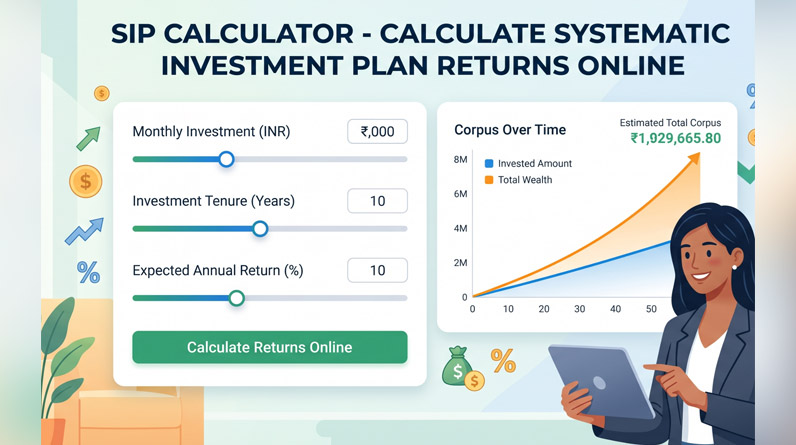
Building long-term wealth does not require a massive upfront fortune. In a dynamic financial landscape, millions of retail investors are turning toward disciplined investing to achieve their milestones. If you want to forecast your financial future with precision, utilizing an online SIP Calculator serves as the perfect starting point to demystify mutual fund returns.
A Systematic Investment Plan (SIP) allows you to invest fixed, manageable amounts into mutual funds at regular intervals, usually monthly. Instead of attempting to time volatile market movements, you benefit from the discipline of regular contributions. An online SIP calculator eliminates guesswork by instantly projecting how your monthly savings can transform into a substantial corpus over time.
What is an SIP Calculator?
An SIP calculator is a smart, automated web tool designed to help investors estimate the future valuation of their regular mutual fund contributions. It acts as a simulation engine. By inputting your planned monthly contribution, the expected annual growth rate, and your total investment timeline, the calculator processes the variables to reveal your estimated maturity value.
While market-linked assets never offer flat, fixed guarantees, an online SIP calculator applies compound interest principles to provide a highly reliable baseline. This allows you to evaluate whether your current savings rate aligns seamlessly with your long-term objectives, such as purchasing a home, funding higher education, or securing an early retirement.
SIP vs. Lumpsum: A Quick Look
Choosing between investing a fixed amount every month or putting in a large sum all at once can be tricky. Monthly investments help you build a disciplined habit and protect you from short-term market drops. However, investing a single large sum works incredibly well if you do it when market prices are very low.
To make the best choice for growing your wealth, it helps to compare both options. Smart investors often use a Lumpsum Calculator alongside monthly tools to run different scenarios. This allows them to see exactly how each method affects their long-term financial goals before deciding where to put their money.
How Does a Systematic Investment Plan Work?
To maximize the utility of a digital calculation tool, it helps to understand the underlying mechanics that drive a Systematic Investment Plan. When you commit to a standard monthly plan, your capital works through two primary financial phenomena:
1. The Power of Compounding
Compounding can be summarized as earning “returns on your returns.” In the initial years of your investment journey, your profits might seem modest. However, as those earnings are continuously reinvested into the fund, they begin generating their own profits. Over a decade or more, this compounding effect snowballs dramatically, turning a regular investment stream into a multi-million dollar portfolio.
2. Rupee Cost Averaging
The financial markets constantly fluctuate. Instead of panicking during market downturns, SIP investors profit from them. When prices drop, your fixed monthly allocation automatically purchases more mutual fund units. Conversely, when prices surge, you buy fewer units. Over time, this natural balancing act lowers your average cost per unit, shielding your portfolio from the detrimental effects of market volatility.
Step-by-Step Guide to Using an Online SIP Calculator
Using an online financial tool is incredibly simple and requires no specialized economic training. Most digital portals provide intuitive sliders to adjust variables instantly.
Step 1: Input Your Monthly Contribution
Decide on an amount you can comfortably automate each month without straining your daily living expenses. Most mutual funds allow allocations to start as low as nominal double-digit figures.
Step 2: Define Your Expected Rate of Return
Enter a realistic percentage based on historical market trends. For instance, long-term equity diversified funds historically average between 12% and 15% annually, whereas conservative debt instruments hover around 6% to 8%.
Step 3: Select Your Investment Horizon
Choose the total number of years you intend to remain invested. Extending this duration, even by just two or three years, can dramatically increase your final maturity value due to late-stage compounding.
Step 4: Analyze the Instant Results
Once the parameters are set, the calculator immediately renders three crucial data points:
- Total Invested Amount: The raw principal capital out of your pocket.
- Estimated Returns: The total wealth generated purely via compounding.
- Total Wealth Accumulated: The overall final valuation of your investment.
Strategic Advantages of Using an Online Valuation Tool
Relying on a digital calculator before putting your hard-earned money to work offers multiple strategic advantages:
- Error-Free Financial Projections: Eliminates the risk of human calculation errors, ensuring your long-term goals are built on reliable mathematics rather than vague estimates.
- Goal-Based Engineering: You can use the calculator in reverse. If you know you need a specific target corpus in 15 years, you can alter the monthly input variable until the tool matches your required final figure.
- Smart Portfolio Adjustments: It empowers you to explore more advanced options like a Step-Up SIP. Increasing your monthly contribution by just 5% or 10% each year as your income grows can easily double your long-term corpus.
Key Considerations to Keep in Mind
While an online SIP calculator is incredibly accurate from a mathematical standpoint, real-world investing involves moving parts that a basic formula cannot fully predict. To maximize your financial success, always account for the following real-world factors:
Market Risk and Volatility
Mutual funds do not deliver perfectly linear returns. An equity fund might experience a 20% surge in one year, followed by a flat or negative performance the next. The percentages used in calculators represent long-term annualized averages rather than fixed yearly returns.
The Impact of Capital Gains Tax
The final value displayed by a basic web calculator represents gross returns. Depending on your geographical jurisdiction and how long you hold the units, your final take-home wealth will be subject to local capital gains taxation laws upon redemption.
Expense Ratios and Exit Loads
Asset Management Companies (AMCs) charge a minor annual fee called an expense ratio to manage your money. Additionally, withdrawing your capital exceptionally early might trigger a minor penalty fee known as an exit load. Always review these small charges, as they slightly alter your net returns.
Conclusion: Take Control of Your Financial Future
Achieving financial freedom is rarely the result of a single lucky break; it is built on consistent, intentional daily habits. Utilizing an online SIP Calculator bridges the gap between vague financial aspirations and a structured execution plan. By visualizing exactly how regular, affordable monthly deposits grow over time, you gain the clarity needed to save confidently.
Whether your long-term roadmap calls for steady monthly savings or strategic lump-sum injections via Lumpsum Calculators, the absolute best time to start your journey is today. Use digital tools to set your targets, automate your monthly contributions, and let the unstoppable power of compounding handle the rest.
