

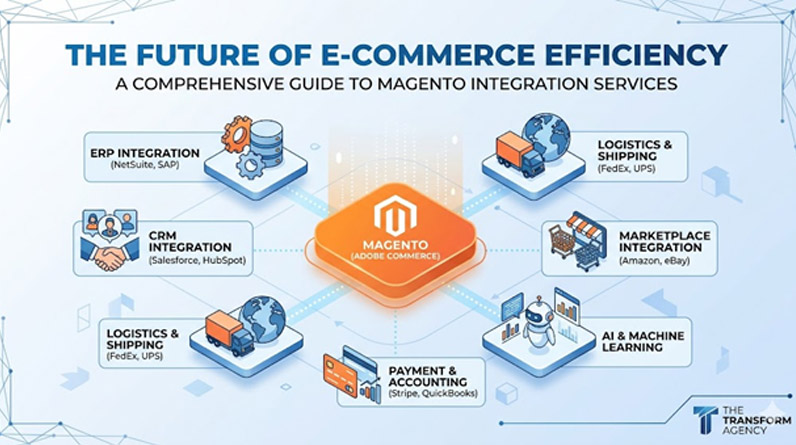
In the rapidly evolving landscape of digital commerce, the distinction between a “store” and an “ecosystem” has become the defining factor for success. Gone are the days when an e-commerce platform could exist as a siloed entity, manually updated by staff and disconnected from the rest of the business. Today, the most successful brands are those that leverage technology to create a seamless flow of data across their entire enterprise.
As Adobe Commerce (formerly Magento) continues to dominate the enterprise market, the focus has shifted from mere web design to complex systems integration.
This article explores why Magento integration is the trending cornerstone of modern retail and how it transforms business operations from the inside out.
The Shift Toward Composable Commerce
The current trend in the Magento ecosystem is the move toward “Composable Commerce.” This approach allows businesses to select and assemble “best-of-breed” solutions for specific functions—such as payment processing, logistics, and customer relationship management—rather than relying on a one-size-fits-all suite.
However, a composable architecture is only as strong as its connections. This is where professional Magento integrations services become vital. By using APIs (Application Programming Interfaces) to link Magento with external software, businesses can ensure that every part of their tech stack “talks” to one another in real-time.
1. Bridging the Gap with ERP Integration
One of the most requested Magento integrations is with Enterprise Resource Planning (ERP) systems like SAP, Microsoft Dynamics, or NetSuite. For a growing business, manual data entry is the enemy of scalability.
When Magento is integrated with an ERP, the benefits are immediate:
- Inventory Synchronization: As soon as a product is sold online, the inventory levels are updated in the ERP, preventing overselling and backorder headaches.
- Order Management: Orders placed on the website are automatically pushed to the ERP for fulfilment, reducing the “order-to-ship” cycle time.
- Customer Data: B2B pricing tiers, credit limits, and purchase histories are synced, allowing for a personalised customer experience.
2. Elevating Customer Experience through CRM Integration
In an era where personalization is no longer optional, integrating Magento with a Customer Relationship Management (CRM) tool like Salesforce or HubSpot is a game-changer.
Magento integration services allow businesses to capture granular data about user behavior. When a customer abandons a cart, that information is sent to the CRM, triggering a personalized email sequence. By having a 360-degree view of the customer, marketing teams can segment audiences with surgical precision, leading to higher conversion rates and increased Customer Lifetime Value (CLV).
3. Streamlining Logistics and Shipping
Shipping is often the most complex part of the e-commerce journey. Trending integrations now focus on connecting Magento directly with global carriers (FedEx, UPS, DHL) and shipping aggregators (ShipStation, Easyship).
Through these integrations, customers get real-time shipping quotes at checkout, and admins can generate labels with a single click. Furthermore, tracking numbers are automatically sent back to the Magento platform and shared with the customer, significantly reducing the volume of “Where is my order?” (WISMO) inquiries to customer support.
4. The Rise of Marketplace Integration
The modern merchant doesn’t just sell on their own website; they sell on Amazon, eBay, Walmart, and Instagram. Managing these channels separately is a recipe for operational chaos.
Advanced Magento integration services enable “Headless” or multi-channel selling. This means Magento acts as the “Single Source of Truth.” You upload a product once in Magento, and the integration pushes that listing, with optimized descriptions and images, to all connected marketplaces. When an item sells on Amazon, the stock level drops on your Magento site and your eBay store simultaneously.
5. Payment Gateway and Accounting Integration
Security and financial accuracy are non-negotiable. Integrating Magento with advanced payment gateways (like Stripe, Adyen, or Braintree) ensures that transactions are secure and support modern methods like Apple Pay, Google Pay, and “Buy Now, Pay Later” (BNPL) services.
On the back end, integrating with accounting software like QuickBooks or Xero automates the reconciliation process. This eliminates human error in financial reporting and ensures that taxes are calculated and recorded accurately across different jurisdictions.
The Technical Edge: Why Professional Services Matter
While Magento offers a robust API, the “trending” aspect of integration isn’t just about making a connection; it’s about the architecture of that connection. Poorly executed integrations can lead to site slowdowns, data corruption, and security vulnerabilities.
By partnering with experts in , businesses benefit from:
Middleware Implementation
Often, the best way to connect Magento to an older legacy system is through middleware (like Celigo or Alumio). These platforms act as a translator, ensuring that data formats are compatible and that the system can handle high-traffic bursts without crashing.
Custom API Development
Sometimes, a “plug-and-play” extension doesn’t exist for a niche business need. Professional integrators can build custom REST or GraphQL APIs that allow Magento to communicate with proprietary internal software, giving the business a unique competitive advantage.
Performance Optimization
Every integration adds a layer of communication. If not optimized, this can increase page load times. Expert services ensure that integrations are “asynchronous,” meaning the website stays lightning-fast for the user while data processes happen in the background.
Real-World Impact: A Case for Integration
Consider a mid-sized electronics retailer. Before integration, they spent 20 hours a week manually updating stock levels from their warehouse and another 10 hours re-typing customer addresses into their shipping software.
After investing in comprehensive Magento integration:
- Labor costs dropped: The staff previously assigned to data entry were moved to customer acquisition roles.
- Errors vanished: Shipping labels were 100% accurate because they were pulled directly from the customer’s input.
- Revenue increased: With real-time inventory, they could confidently run “Flash Sales” without the fear of selling stock they didn’t have.
The Future: AI and Machine Learning Integration
The next frontier for Magento integration is Artificial Intelligence. We are already seeing a trend where Magento is integrated with AI engines to provide:
- Visual Search: Allowing customers to upload a photo to find similar products.
- Predictive Analytics: Integrating with tools that predict when a customer is likely to churn or what they are likely to buy next.
- Dynamic Pricing: Automatically adjusting prices based on competitor data and market demand.
Conclusion
Magento is a powerhouse of a platform, but its true potential is only unlocked when it functions as the heart of a fully integrated digital ecosystem. Whether it’s connecting to an ERP to streamline operations, a CRM to boost marketing, or a global logistics provider to enhance fulfillment, integration is the key to modern e-commerce scaling.
In a competitive market, you cannot afford to have “data islands.” Investing in professional is no longer a luxury—it is a strategic necessity for any brand looking to provide a world-class shopping experience while maintaining peak operational efficiency.
By automating the mundane and connecting the complex, Magento integration allows business owners to stop working in their business and start working on their business. The future of retail is connected; ensure your platform is ready to lead the way.
Frequently Asked Questions (FAQs)
What exactly are Magento integration services?
involve connecting your Magento (Adobe Commerce) storefront with other essential business applications. This is done primarily through APIs (Application Programming Interfaces) or middleware, allowing data to flow automatically between systems like ERPs, CRMs, accounting software, and shipping carriers.
How long does a typical Magento integration project take?
The timeline varies based on complexity:
- Basic Integrations: Standard connections via pre-built extensions (e.g., connecting a common payment gateway) can take a few days.
- Custom ERP/CRM Integrations: Complex setups involving custom data mapping and legacy systems typically take 4 to 8 weeks or more to ensure rigorous testing and data integrity.
Will integrating third-party tools slow down my website?
If done poorly, yes. However, professional integration services use asynchronous processing and middleware orchestration. This means the heavy data syncing happens in the background without affecting the “frontend” speed or the user’s shopping experience.
Is it better to use a pre-built extension or a custom API integration?
- Pre-built Extensions: Faster and more cost-effective for standard needs (e.g., Mailchimp or QuickBooks).
- Custom API Integrations: Better for unique business logic, high-volume data, or proprietary software. It offers more flexibility and is generally more “future-proof” as your business scales.
Can I integrate Magento with physical retail (POS) systems?
Absolutely. Integrating Magento with your Point of Sale (POS) system is a trending “Omnichannel” strategy. It ensures that if a customer buys the last item in your physical store, your online website immediately shows that item as “Out of Stock,” preventing overselling.
What are the most critical integrations for a growing B2B business?
For B2B, the “Holy Trinity” of integration includes:
- ERP Integration: For real-time inventory and tiered pricing.
- CRM Integration: For managing complex sales cycles and lead nurturing.
- PIM (Product Information Management): To manage thousands of SKUs and technical specifications across multiple channels.
